
 May 6 2026
There is a friend who books his honeymoons partly around hotels he saw in films as a teenager. The Bellagio. The Plaza. Monte Carlo. None of these places were on his actual itinerary because of their amenities. They were on the itinerary because their names had earned a place in his imagination decades earlier, often through casino imagery on screen. That kind of brand inheritance is hard to manufacture and impossible to fake, and it sits at the center of how heritage casino names continue to operate in 2026.
When a regulated online casino market opens, dozens of operators compete for attention. Players have to choose where to play, often based on minimal information. A heritage brand has a quiet advantage in this moment: the player already knows the name. They may have seen the physical property, watched it in films, or simply absorbed the name through years of media exposure. The brand has done its trust-building work over decades, before the player ever opened the app.
This is especially valuable in a category where trust matters intensely. A Forbes piece on the role of legacy brands in a digital age walked through how legacy names continue to outperform newer competitors when consumers face decisions that involve money, regulation, and personal data. Casino services hit all three buckets, which makes heritage advantage particularly real.
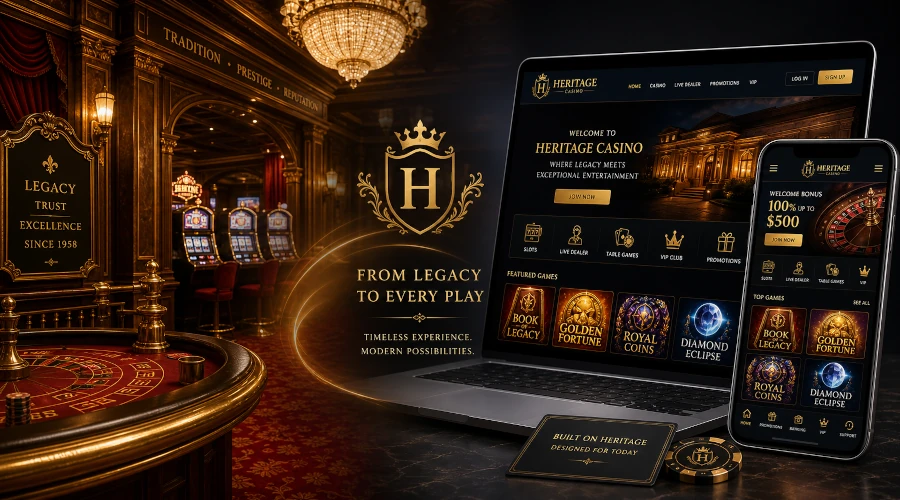
Heritage casino brands have visual signatures that have evolved over decades. Color palettes, typography, logo treatments, and architectural motifs all combine into a distinct look. When the brand moves online, the question is how much of that visual signature to bring forward. Too little, and the digital product feels disconnected from the heritage. Too much, and the digital product feels like a museum exhibit rather than a modern app.
The successful translations split the difference. They preserve the unmistakable elements — the logo, the color sense, the overall mood — while modernizing the layout and interaction patterns. Players who arrive at Golden Nugget Casino in eligible states see immediate visual continuity with the broader Golden Nugget identity, while the actual interaction model is built for modern devices and modern user expectations.
Heritage casinos have specific game preferences that reflect their identity. Some are slot-heavy, some lean toward table games, some have particular variants they emphasize. When the brand moves online, the catalog choices matter. A heritage brand that has always emphasized table games and then ships an online product dominated by slots creates dissonance.
The strongest digital launches respect the brand's heritage in their game selection. Table games front and center if the brand has historically been a table-game destination. Premium slot partnerships if the brand has emphasized that category. The player should feel that the digital catalog is a sensible extension of what the brand has always offered, not a generic catalog with the brand pasted on top.
Audio is one of the most underrated tools in translating casino heritage online. The ambient sounds of a particular casino floor — the specific mix of slot audio, the particular acoustics of the space, even the kind of music that plays in the background — contribute enormously to how the place feels. Digital environments can recreate this surprisingly well, with thoughtful sound design that evokes rather than recreates the physical space.
I have noticed that heritage brand apps with strong audio design feel meaningfully more brand-aligned than apps that use generic audio libraries. The audio cues are subtle — a specific bell tone for wins, a particular ambient bed in lobbies, a recognizable jingle on key transitions — but they accumulate into a sense of place that helps the digital product feel like a real extension of the brand.
Heritage casinos often have well-developed loyalty programs that reward returning players with status, comps, and special access. Translating these programs to online play is more challenging than it sounds. The mechanics have to work across digital formats, and the rewards have to feel meaningful in a context where the player is not physically present at the property.
The brands that handle this well think of the loyalty program as a single program that operates across both the physical property and the digital product. A player earning rewards online can use them at the physical casino. A player earning rewards in person sees their status reflected online. The integration sounds technical, but it is one of the most powerful expressions of brand continuity for players who use both channels.
For players who have never visited the physical property, a heritage casino brand still carries weight, but the source of that trust is different. They trust the name because they have seen it in films, read about it in travel articles, or heard it referenced in cultural discussions. A New York Times piece on heritage and brand legacy in the world today, and the effect is measurable in modern marketing data.
These culturally-trusting players are an important audience for online launches. They are willing to give the brand a chance based on the name alone, without needing additional persuasion. The challenge for the operator is to deliver a digital experience that does not undermine the implicit trust the player brought in. Disappointing this audience produces lasting damage to the brand.
Heritage casino brands have stories that can be told. The history of how they were founded, the famous moments that happened on their floors, the celebrities and characters associated with them, the architectural and design innovations they introduced — all of these are marketing assets that newer brands cannot replicate.
Smart digital teams use these stories. They show up in onboarding flows, in promotional content, in app-store descriptions, and in social media presence. The stories create a sense that the player is engaging with something larger than a software product. They are participating in a tradition. That sense of participation is one of the most durable forms of customer loyalty available.
There is a failure mode for heritage brand digital products: leaning so hard on the heritage that the product feels like a museum exhibit. The fonts are too retro, the visual style is too dated, the marketing copy reads like a history book. Players who want a modern app find themselves using a product that feels like it was designed for their grandparents.
The best translations respect heritage without becoming captive to it. They preserve what is timeless — the brand mark, the sense of quality, the emotional associations — while building the actual user experience on modern foundations. The product feels like a contemporary app from a brand with deep roots, not like an antique trying to function as a modern tool.
Several heritage casino brands have expanded into sports betting alongside their casino offerings. The combination has worked well in markets where it is permitted, because the brand's reputation extends across both categories. Players who trust the brand for casino games tend to trust it for sports betting as well, and vice versa. The integration creates network effects that newer single-vertical operators have a harder time matching.
This is one of the strategic advantages of operating under a heritage brand in the modern era. The brand serves as connective tissue across multiple product lines, and the player can bring their trust from one category to another. The trust does not have to be re-earned each time the brand expands into a new vertical.
Heritage brands tend to think on long time horizons because they have already operated on long time horizons. The Golden Nugget has been part of the casino landscape for many decades. The decisions being made about its digital presence today are shaped by an awareness that the brand has to remain relevant for many decades more. That long view affects everything from product design to marketing tone to customer service philosophy.
Newer operators do not have this same instinct, because they do not have the same history to protect. They optimize for shorter horizons. Sometimes that produces faster innovation; sometimes it produces decisions that look great in the short term and damage the brand's long-term position. Heritage brands are structurally protected against the worst version of short-termism, even when they are slower to move.
When a storied casino brand translates online, the question is not whether the heritage matters — it does — but whether the operator handles the translation with the care the heritage deserves. The successful examples preserve what is timeless, modernize what needs modernizing, and produce digital products that feel like genuine extensions of decades of brand-building. Players who care about heritage notice the difference, and the brands that get this right tend to outperform more generic competitors over time.


Curacao-License

Curacao-License
 There is a No Deposit Bonus available: 30 Free Spins



Curacao-License

Curacao-License


Malta-License (EU)


Curacao-License
There is a No Deposit Bonus available: 20 Free Spins
Curacao-License
There is a No Deposit Bonus available:
25 Free Spins

Curacao-License
There is a No Deposit Bonus available: 30 Free Spins

Curacao-License
There is a No Deposit Bonus available: 100 Free Spins

Curacao-License

Curacao-License

Curacao-License

Curacao-License
There is a No Deposit Bonus available: 25 Free Spins

Curacao-License


 United States: