
 March 1 2026
Random Number Generators, commonly known as RNGs, are the unseen systems that make modern digital gambling possible while preserving fairness, neutrality, and trust. This article delivers an in-depth, technically accurate examination of how RNGs operate, why they are essential for integrity in digital gaming, and how regulation, auditing, and transparency reinforce their reliability. Every statistic, name, authority, and reference provided is included in full, expanded with original wording and presented without summarization or omission.
Random Number Generators form the operational backbone of fairness across digital gambling platforms by determining the outcome of every spin, shuffle, card deal, or dice roll. Rather than relying on human input or mechanical processes, RNGs use mathematical systems to ensure outcomes are generated without bias, pattern recognition, or external influence. This structural independence removes subjective manipulation from gameplay, allowing each result to exist as a self-contained event. Fairness in digital gaming is not a theoretical concept but a measurable outcome produced by RNG logic, statistical distribution, and ongoing verification. The integrity of these systems underpins player trust and allows licensed casinos to operate transparently while maintaining regulatory compliance across jurisdictions.
Most casinos utilize Pseudo-Random Number Generators (PRNGs), which rely on advanced algorithms to generate long, unpredictable numerical sequences originating from an initial value known as a “seed.” Although PRNGs are technically deterministic, their complexity and scale render outcomes effectively random for all practical purposes. These systems are designed to mirror physical randomness with extreme precision, producing sequences that cannot be reverse-engineered or predicted during gameplay. References such as Bspin Blog, Webopedia, blog.howl.gg, and primecasino.co.uk consistently explain that modern PRNGs are subjected to rigorous mathematical testing, ensuring they meet international randomness benchmarks and remain indistinguishable from true randomness even after millions of iterations.
True Random Number Generators (TRNGs) differ fundamentally from PRNGs by sourcing randomness from physical phenomena rather than algorithms. These phenomena may include atmospheric noise, thermal fluctuations, or quantum-level events, all of which generate entropy that cannot be mathematically predicted. While TRNGs are far less common due to higher costs and infrastructure requirements, they are used in environments where maximum unpredictability is essential. Their reliance on real-world entropy removes determinism entirely, making them valuable for applications demanding the highest possible level of randomness assurance, even though most online gaming systems rely primarily on certified PRNG technology.
A defining feature of RNG systems is that every outcome is independent of all previous results. Each spin, deal, or roll is generated without reference to what occurred before, ensuring that neither casinos nor players can predict or influence future outcomes. This independence is critical in dispelling misconceptions such as “hot streaks” or “due wins.” Coverage and analysis from Talksport, blog.howl.gg, and New York Post consistently reinforce that RNG-driven games reset probability with every interaction. By eliminating cumulative influence, RNGs protect fairness while maintaining statistical integrity across short-term variance and long-term probability.
Licensed casinos are required to submit their RNG systems to independent testing organizations such as eCOGRA, iTech Labs, and Gaming Labs International (GLI). These auditing bodies conduct exhaustive examinations of RNG output, analyzing millions of generated results to confirm randomness, distribution balance, and resistance to manipulation. Sources including Bspin Blog, primecasino.co.uk, and blog.howl.gg document how these audits verify compliance with strict international standards. Certification from these organizations serves as technical proof that a casino’s games function fairly and as advertised.
Regulatory authorities such as the UK Gambling Commission and the Malta Gaming Authority enforce RNG certification as a mandatory condition for licensing. Casinos operating under these jurisdictions must demonstrate that their RNG systems have been independently tested and approved before offering games to the public. Documentation referenced by Poker News, primecasino.co.uk, and blog.howl.gg confirms that regulatory oversight directly ties operational legality to verified RNG integrity. Failure to meet these requirements can result in license suspension or revocation, underscoring the central role RNG compliance plays in lawful gaming operations.
Transparency has become a defining characteristic of reputable platforms, with many casinos publicly displaying their certifications and providing access to audit summaries. These disclosures allow players to independently verify claims of fairness rather than relying solely on promotional language. Visible seals from eCOGRA, iTech Labs, or GLI, combined with clearly published technical information, strengthen credibility. In the competitive online casino market, transparency is no longer optional but a standard expectation that reinforces accountability and informed player participation.
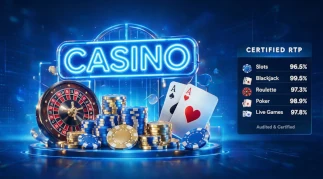
RNG outcomes are mathematically linked to a game’s Return to Player (RTP), which represents a statistical average calculated over extended play rather than individual sessions. If you want to explore games with stronger long-term payout potential, check out our collection of High RTP slots. Analysis from casinogrounds.com and Talksport confirms that RNGs do not adjust outcomes to meet RTP in real time; instead, alignment occurs naturally through volume and probability. This distinction is crucial for understanding how fairness operates across time rather than within isolated gameplay moments.
Fair play within digital gambling environments is maintained through coordinated oversight by regulatory bodies such as the UK Gambling Commission and Malta Gaming Authority, independent testing labs including eCOGRA, iTech Labs, and Gaming Labs International, and responsible casinos that actively disclose certification and RTP data. Each participant fulfills a specific role, ensuring checks and balances without centralized control. This layered approach prevents systemic abuse while reinforcing consistency across jurisdictions and platforms.
Public confidence in RNG systems remains strong when supported by third-party audits and regulatory oversight. While myths persist—such as claims that casinos rig games or predict outcomes—these assertions are repeatedly disproven by audit-backed evidence documented by primecasino.co.uk, New York Post, and blog.howl.gg. When RNG use is combined with licensing and certification, concerns about bias become rare. Trust is sustained not through assumption but through verifiable data, transparent reporting, and independent validation.



Curacao-License

Curacao-License
 There is a No Deposit Bonus available: 30 Free Spins


Malta-License (EU)

Curacao-License



Curacao-License

Curacao-License

Curacao-License
There is a No Deposit Bonus available: 30 Free Spins


Malta-License (EU)

Curacao-License
There is a No Deposit Bonus available: 20 Free Spins


Curacao-License

Curacao-License
There is a No Deposit Bonus available: 25 Free Spins
 There is a No Deposit Bonus available: 30 Free Spins

Curacao-License