

 March 26 2026
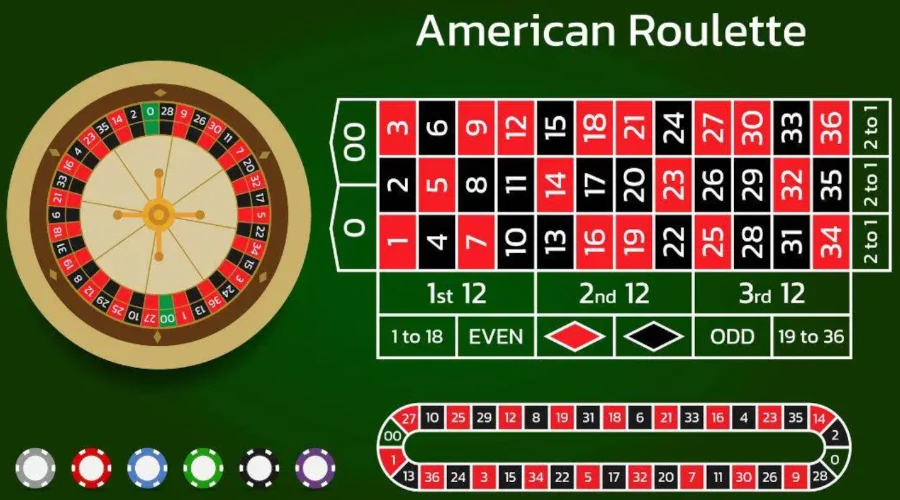
European and American roulette follow the same rules on the surface. You place chips on a betting grid, the dealer spins the wheel, and the ball lands in a numbered pocket. That visual similarity often confuses players because both tables look almost identical during play. The key difference lies in the wheel itself, not in the betting feel. European roulette has 37 pockets: numbers 1-36 and a single zero. American Roulette has 38 pockets because it adds a double zero, and that extra pocket changes the odds on every bet at the table. That single addition has a clear effect on the math.
In European Roulette, a straight-up bet on one number has a 1 in 37 chance of winning. In American Roulette, the same bet drops to 1 in 38, even though the payout stays the same at 35 to 1. The same gap affects outside bets too. A red or black wager looks simple, yet the extra double zero gives the house another way to beat the player. For a beginner, the takeaway is simple: the American wheel gives the casino a bigger edge. For an experienced player, that difference matters because it raises expected loss over time without offering any better payout in return. Both versions are easy to find online now, often on the same casino site. Players usually compare several factors before choosing a table, including limits, interface, and available promotions. For example, someone who prefers a particular casino might first check the latest bonus list to see if they can claim a Slots of Vegas no deposit bonus code and only then decide which roulette table to open according to the bonus terms. After that step, the choice between European and American roulette becomes important because the type of wheel directly affects the mathematical cost of every bet placed during the session.
Once the difference between the two wheels is clear, the next question becomes practical: how much does that extra pocket actually change the outcome of a session? The answer appears when the probabilities are translated into expected loss. Casinos design roulette so that payouts remain fixed while the odds slightly favor the house. When the number of pockets increases but the payout remains unchanged, the mathematical margin shifts further toward the casino. This is exactly what happens with the double zero on the American wheel. To see how the system works in real play, consider a simple betting pattern. A player places $10 per spin and completes 100 spins during a session. The total amount wagered during that time equals $1,000. In European Roulette, the theoretical cost of that session is about $27. On the American wheel, the same betting pattern produces an expected loss of roughly $52.60. The experience at the table may feel identical, yet the statistical pressure on the bankroll becomes almost twice as strong.
The same principle applies regardless of betting style. A player focusing on outside bets such as red/black or odd/even still faces the same mathematical margin built into the wheel. Players who prefer inside bets with higher payouts encounter the same difference because every outcome still follows the same probability system. The extra pocket does not change how the game looks, but it quietly changes how the numbers behave over time.
| Roulette Version | Typical House Edge | Expected Loss per $100 Wagered | Expected Loss After $1,000 Wagered |
|---|---|---|---|
| European Roulette | 2.70% | $2.70 | $27 |
| American Roulette | 5.26% | $5.26 | $52.60 |
Seen this way, the difference between the two wheels is not just theoretical. Over a long session or repeated visits to the table, the higher house edge gradually reduces the player's bankroll at a faster rate. This is why experienced players usually look for the single-zero wheel when both options are available. The rules remain the same, but the underlying math works slightly more in the player's favor.
Roulette bets fall into two categories: inside bets and outside bets. Inside bets cover specific numbers or small groups of numbers located in the center of the betting grid. Examples include straight bets, split bets, and street bets. These wagers offer higher payouts because the probability of success is lower. Outside bets cover wider number groups such as red or black, odd or even, or the ranges 1-18 and 19-36. These wagers pay 1 to 1 and occur more frequently during a session. Consider a player who places a straight bet on number 8 with a $5 chip. In European Roulette the probability of winning equals about 2.70 percent. The payout equals $175 plus the original $5 stake. In American Roulette the payout remains $175, yet the probability drops slightly because the double-zero pocket expands the total number of outcomes. Even a difference smaller than one-tenth of a percent can influence long sessions that involve dozens or hundreds of spins. Outside bets reveal the statistical gap even more clearly. A wager on red covers 18 numbers on the wheel. European Roulette leaves 19 losing pockets, including the zero. American Roulette increases that count to 20 losing pockets due to the double zero. A player who repeats a $10 red bet over 200 spins theoretically risks $2,000 in wagers. Under European rules the expected loss averages about $54. The same sequence on an American wheel increases the expected loss to roughly $105.
Roulette outcomes follow fixed probability, so the goal during a session is not to predict results but to control risk. Several practical guidelines help maintain control during roulette play:
These decisions do not change the odds, but they determine how effectively a bankroll withstands the statistical pressure built into the game.
Although European and American roulette share the same core gameplay, casinos often introduce modified versions built on these two formats. These variations keep the original wheel layout but add rule adjustments, visual changes, or additional betting features. In most cases, the purpose is either to create a slightly different playing experience or to introduce new betting options while keeping the familiar roulette framework. Many of these variations appear in online casinos and live dealer studios. Some focus on improving conditions for certain bets, while others introduce multipliers or bonus mechanics that increase volatility. Understanding these differences helps players identify which tables follow the classic rules and which introduce additional elements that may influence risk and payout potential.
The table below highlights several well-known variations that are based specifically on European or American roulette wheels.
| Variation | Based on Wheel Type | Key Rule or Feature | Effect on Gameplay |
|---|---|---|---|
| European Roulette with La Partage | European (single zero) | Half of even-money bet returned if zero lands | Reduces house edge on even-money bets |
| European Roulette with En Prison | European (single zero) | Even-money bets remain active for the next spin after zero | Offers a second chance to recover the stake |
| Lightning Roulette | European (single zero) | Random number multipliers up to large payouts | Higher volatility with potential boosted winnings |
| Double Ball Roulette | European (single zero) | Two balls spin simultaneously on the wheel | Allows two results in a single round |
| Triple Zero Roulette | American-style wheel | Adds an extra green pocket (000) | Significantly increases the house edge |
These variations illustrate how casinos expand the traditional roulette format while keeping the familiar betting layout. Some versions introduce player-friendly rules, particularly those built on the European wheel, while others increase volatility through multipliers or additional pockets. For players comparing tables, the key step remains the same: check the wheel type and rule adjustments before placing the first bet.
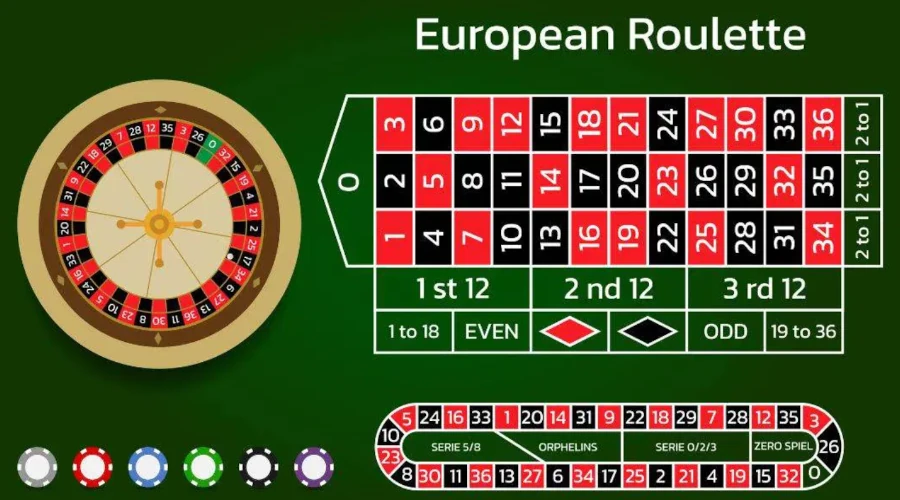
European and American roulette may look almost the same during play, but the conditions behind the game are different. Because of this, players who care about long sessions usually pay attention to the table they choose before placing a bet. A roulette table should be evaluated the same way as any other casino game. Players often check limits, available rules, and game format before they start. Small details can change how comfortable a session feels and how long a bankroll lasts. For that reason, careful players rarely open the first roulette table they see. Taking a moment to review the game conditions helps avoid unnecessary risk and leads to a more controlled playing session.


Curacao-License





Curacao-License
 There is a No Deposit Bonus available:
25 Free Spins
There is a No Deposit Bonus available:
25 Free Spins

Curacao-License
There is a No Deposit Bonus available: 30 Free Spins

Curacao-License
There is a No Deposit Bonus available: 25 Free Spins


Malta-License (EU)

Curacao-License

Curacao-License
There is a No Deposit Bonus available: 25 Free Spins

Curacao-License
There is a No Deposit Bonus available: 20 Free Spins

Curacao-License

Curacao-License
There is a No Deposit Bonus available: 20 Free Spins
 There is a No Deposit Bonus available: 30 Free Spins

Curacao-License